
函数式参数#
Python语言的一个核心概念是函数式编程:我们定义函数并将其应用于我们的数据。
import numpy as np

values = np.asarray([1, 2, 3, 4, 10])
def double_number(x):
    return x * 2
double_number(values)
array([ 2, 4, 6, 8, 20])
在Python中,你也可以有包含函数的变量,并且可以执行它们:
my_function = double_number

my_function(values)
array([ 2, 4, 6, 8, 20])
自定义函数式参数#
你还可以定义自己的接受函数式参数的自定义函数。例如,我们可以定义一个count_blobs函数,它接受一个image和一个threshold_algorithm函数作为参数。
import matplotlib.pyplot as plt
from skimage.measure import label

def count_blobs(image, threshold_algorithm):
    # binarize the image using a given
    # threshold-algorithm
    threshold = threshold_algorithm(image)
    binary = image > threshold

    # show intermediate result
    # plt.imshow(binary)

    # return count blobs
    labels = label(binary)
    return labels.max()
现在我们打开一张图像并对其进行两次分析。
from skimage.io import imread, imshow

blobs_image = imread('../../data/blobs.tif')

imshow(blobs_image)
<matplotlib.image.AxesImage at 0x17968acd0>
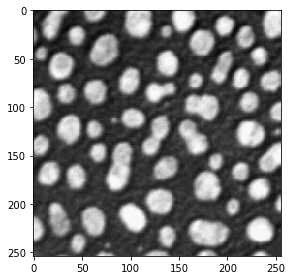
现在我们用两种不同的算法作为参数来计算这张图像中的斑点数量:
from skimage.filters import threshold_otsu

count_blobs(blobs_image, threshold_otsu)
64
from skimage.filters import threshold_yen

count_blobs(blobs_image, threshold_yen)
67
练习#
假设你想找出哪种阈值算法最适合你的图像。因此,你可能想看看图像被多个算法阈值化的效果。定义一个阈值算法列表,例如从这个列表中选择。编写一个for循环,将这些阈值算法应用于斑点图像并显示结果。结果应该类似于这个例子。